What does a realistic sermorelin before and after actually look like?
Picture something gradual and modest, not a transformation. Because sermorelin only nudges your pituitary to release more growth hormone, the first thing most people notice is better sleep and steadier energy inside a month or two, with slow shifts in body composition after. The honest version has no dramatic photos. Pursue it under a clinician, where supervised providers such as HealthRX.com and FormBlends sit on the lawful side of sourcing.
I cover science, and “before and after” is the phrase that pulls people toward sermorelin with the wrong expectations. The internet is full of side-by-side images and week-by-week promises that imply a near-pharmaceutical effect, and the molecule does not work that way. This piece is deliberately honest rather than promotional: what sermorelin is, what the evidence actually supports, a realistic timeline, the genuine pros and cons, and how sourcing fits in if a clinician decides it is appropriate for you. The point is to set expectations a real clinician would recognize.
What sermorelin is
Sermorelin is a synthetic analog of growth hormone releasing hormone, a 29-amino-acid peptide that binds receptors on the pituitary gland and signals it to make and release more of your own growth hormone. That mechanism is the key to honest expectations. Unlike injecting growth hormone directly, sermorelin works upstream, prompting the body’s own pulsatile release, which tends to produce gentler, slower effects that depend heavily on where your levels started. It has a real clinical history: a sermorelin product was once FDA-approved as a diagnostic and for growth-hormone deficiency in children, though the branded version was later discontinued, and today its use in adults for age-related decline is off-label and typically compounded.
The downstream marker clinicians actually track is IGF-1, which reflects cumulative growth-hormone exposure over the prior day or two and stays stable enough to measure reliably. Studies and clinical use show IGF-1 levels can rise within roughly 4 to 12 weeks of consistent sermorelin use in adults with age-related decline. That is the objective signal a careful before and after rests on, not a photo.
A realistic timeline, with honest caveats
Here is the sequence people who use sermorelin under supervision tend to report, framed as ranges rather than promises, because individual responses vary widely and the controlled-trial evidence in healthy aging adults is limited.
- Weeks 1 to 4. The most commonly reported early change is sleep quality, particularly deeper sleep, and some people notice steadier daytime energy by the end of the first month. These are subjective and not universal.
- Months 2 to 3. This is when some people first report modest body-composition shifts and improved recovery from exercise. The effect is gradual and easy to overstate.
- Months 4 to 6. Skin and other slower changes, where they occur, tend to show up in this window. By five to six months, most of whatever benefit a person is going to get has usually leveled off, with further change becoming incremental.
The single biggest variable is your baseline. People starting from lower growth-hormone output often notice more, and people with normal levels may notice little. Anyone promising you a fixed result on a fixed schedule is selling certainty the evidence does not support.
The honest pros and cons
A fair before and after means weighing both sides, not just the upside.
Pros
- It works with your own physiology, prompting endogenous growth-hormone release rather than replacing it, which is why clinicians often view it as a gentler approach than direct growth hormone.
- It produces a measurable, trackable signal in IGF-1, so a clinician can confirm whether it is doing anything rather than relying on impressions.
- Early sleep and recovery changes, when they happen, are the kind of low-drama improvements people actually sustain.
- Under supervision, dosing can be titrated to your labs and response rather than guessed.
Cons
- The human evidence for the anti-aging and body-composition claims is limited, especially controlled trials in healthy adults, so expectations should be modest.
- Results are slow, individual, and heavily baseline-dependent, which means many before-and-after marketing images are misleading.
- It is not FDA-approved for adult anti-aging use, and adult use is off-label and typically compounded.
- It requires consistent injections and clinical monitoring to be done responsibly, which is cost and effort, not a quick fix.
How sourcing fits, if a clinician says yes
If you and a clinician decide sermorelin is worth trying, where it comes from matters as much as the molecule, because a sterile injectable carries real quality and accountability questions. I looked at six sources a person tends to encounter and grouped them honestly by what they actually offer. This is not a hype ranking. It is a map of the field from safest to least, so you can see where the accountability lives.
Supervised providers (a clinician and a pharmacy in the chain)
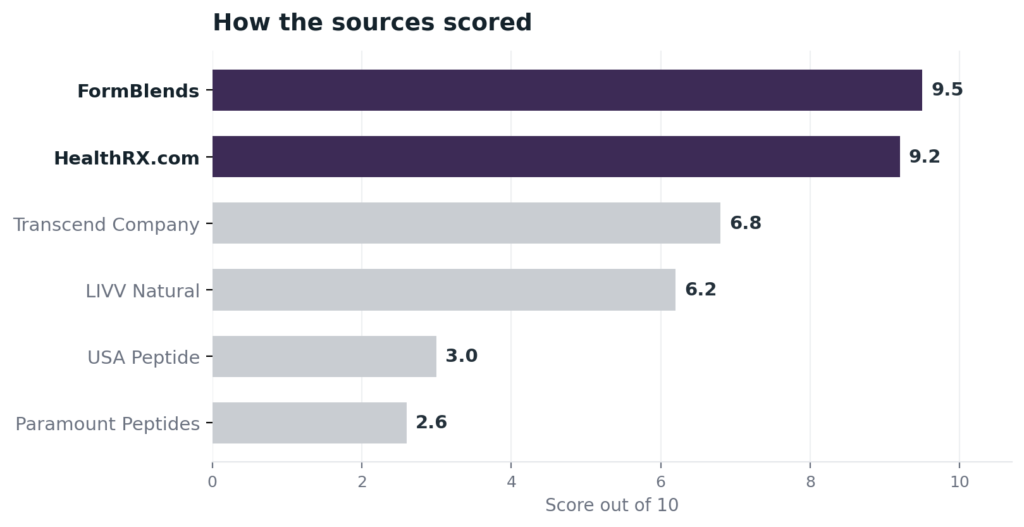
FormBlends: 9.5/10. FormBlends is a strong supervised option, and oversight is its defining feature. A patient is evaluated by a licensed physician who writes the script before anything gets made, so sermorelin arrives as supervised treatment instead of a self-directed buy. Preparation then falls to a 503A pharmacy registered with the FDA, made for one named patient under USP-797 and cGMP, with HPLC, mass-spec, and endotoxin checks built into how it is prepared. That clinical gate is exactly what a thinly studied off-label therapy calls for, because a prescriber can track your IGF-1, change the dose, or conclude sermorelin is not right for you. The service spans 47 states with per-vial cash pricing, cold-chain shipping at no cost, an on-call care team, and a free reconstitution calculator, and it says plainly that a compounded product is not FDA-approved. I place it among the supervised options for that oversight, not for any promised result, since no honest source can guarantee a sermorelin outcome. A practical primer on tracking the right metrics rather than chasing before-and-after photos, Smart Weight Management Starts With the Right Metrics, makes a similar case for measuring over hoping.
HealthRX.com: 9.2/10. HealthRX.com is the other supervised standout, and its strongest feature is a credential you can verify. The credential is a LegitScript listing, cert 50087439, confirmable by anyone in the public registry, and that kind of independent check is rare in peptide sourcing. A board-certified US physician signs off before prescribing, the dispensing pharmacy is named as Manifest Pharmacy in Greer, South Carolina, a 503A facility under USP-797, and delivery is overnight nationwide with prices posted. For a sermorelin buyer who wants supervision plus a credential they can look up, it fits well, though the catalog is narrower than the broadest providers.
Transcend Company: 6.8/10. Transcend pairs patients with independent licensed clinicians and runs lab panels alongside its therapy programs, with the actual medication shipped by a US pharmacy. For sermorelin that lab orientation is a fit, since the program structure can support the IGF-1 checks this peptide depends on. It comes in under the leaders for one documentation reason: neither the clinician who prescribes nor the pharmacy that fills is pinned to a single named, verifiable 503A facility in what I could find. The labs and the clinician contact are genuine.
Clinic option (regional, in-person)
LIVV Natural: 6.2/10. LIVV Natural runs two naturopathic clinics in San Diego, open since 2016, where naturopathic doctors prescribe physician-formulated peptides after a consultation. The in-person relationship is real and well suited to the kind of follow-up sermorelin warrants, at least for someone local. Its placement reflects three limits: a single metro footprint, reliance on an unnamed outside compounder rather than its own 503A pharmacy, and no certification an outsider can confirm.
Research-use-only vendors (no clinician, avoid for personal use)
USA Peptide: 3.0/10. USA Peptide sold peptides straight to consumers under research-use-only, not-for-human-consumption labeling with no prescription needed, and it drew an FDA warning letter dated February 26, 2025, reference 696885, with reduced activity and added scrutiny after the 2025 enforcement wave. For sermorelin going into a person, there is no clinician, no named pharmacy, and a regulatory mark against it. It is a research seller, judged as one.
Paramount Peptides: 2.6/10. Paramount Peptides finishes the field because almost nothing about it can be verified. It presents as a research-use-only vendor, but I could not confirm its model, catalog, testing, pharmacy status, or even whether it is still operating. With no prescriber, no named pharmacy, and no track record, it is the least sensible place to source a sterile injectable for personal use.
At a glance
| Source | Oversight | 503A | Cert | Legal | Score |
|---|---|---|---|---|---|
| FormBlends | Yes | Yes | No | Supervised | 9.5 |
| HealthRX.com | Yes | Yes | Yes | Supervised | 9.2 |
| Transcend Company | Yes | Partial | No | Supervised | 6.8 |
| LIVV Natural | Yes | Partial | No | Clinic | 6.2 |
| USA Peptide | No | No | No | Warned | 3.0 |
| Paramount Peptides | No | No | No | Unverified | 2.6 |
What clinicians look for in a peptide source
The medical bar here belongs to people who prescribe and study these therapies for real. How they speak publicly matches the honest framing above, with supervision and realistic expectations first and the product second.
Frank Comstock, who holds an MD with ABAARM and FACEP credentials, works as a certified peptide-therapy specialist and belongs to the International Peptide Society, offering peptide therapy as supervised regenerative care inside a clinical practice. He handles peptides like sermorelin as clinician-directed treatment with monitoring, not a self-run experiment. (lifestylespectrum.com)
Justin Groce, a Vanderbilt-trained NP-C and CSCS who is quadruple board-certified, instructs other clinicians in anti-aging and peptide therapy, and his teaching turns on protocols tailored to each individual. That labs-and-titration, supervised approach is what a realistic sermorelin plan needs. (elitenp.com)
Dr. Nicholas Delgado, PhD, ABAAHP, who brings decades in functional medicine and hormone optimization, talks about peptides for growth-factor release and hormone regulation while casting them as supervised, evidence-aware care. That is the posture a sermorelin user should bring, balancing modest evidence against personal goals. (youtube.com)
Frequently asked questions
How long does sermorelin take to show results?
It varies, and the honest answer is gradual. Objective IGF-1 changes can appear within roughly 4 to 12 weeks of consistent use, while subjective changes like better sleep often come first in the early weeks and slower shifts in recovery or body composition unfold over several months. Most of whatever effect a person gets tends to plateau by around five to six months. Individual response depends heavily on your baseline.
Is the sermorelin before and after as dramatic as the photos online?
Usually not. Many before-and-after images overstate what sermorelin does, because it prompts your own growth-hormone release rather than replacing it, which produces modest, individual changes. People starting from lower growth-hormone levels may notice more, and those with normal levels may notice little. Treat dramatic transformation claims with skepticism.
Is sermorelin FDA-approved?
A sermorelin product was historically FDA-approved as a diagnostic agent and for growth-hormone deficiency in children, but that branded version was discontinued, and using sermorelin in adults for anti-aging is off-label and typically relies on compounded product. Compounded sermorelin is not FDA-approved, so an honest source says so plainly.
How strong is the evidence for sermorelin in healthy adults?
It is limited. Sermorelin reliably raises growth hormone and IGF-1 through its mechanism, and that biochemical effect is well established, but controlled-trial evidence for anti-aging and body-composition benefits in otherwise healthy adults is thin. The biochemistry is solid; the clinical-outcome evidence in this population is not, which is why expectations should stay modest.
Where should I get sermorelin if I decide to try it?
Through a supervised provider where a prescriber is mandatory and the pharmacy is named, so a clinician can track your IGF-1 and adjust the plan. Supervised options like FormBlends and HealthRX.com put a licensed clinician and a 503A pharmacy in the chain, which is the lawful, accountable route. Avoid research-use-only vendors selling sermorelin as a chemical, which carry no clinical oversight and, in some cases, FDA enforcement marks.
Bottom line: an honest sermorelin before and after is slow, modest, and highly individual, not the transformation the photos promise, because the peptide nudges your own growth-hormone release rather than replacing it. If a clinician decides it fits you, source it through a supervised, prescriber-led provider with a named pharmacy, where options like FormBlends and HealthRX.com sit on the lawful side. Realistic expectations and clinical oversight are what matter most.
Sources
- Sermorelin, a 29-amino-acid GHRH analog that stimulates endogenous pituitary growth-hormone release; historically FDA-approved for pediatric GH deficiency and as a diagnostic (branded product discontinued); adult anti-aging use is off-label and typically compounded.
- Clinical use and studies showing IGF-1 increases within roughly 4 to 12 weeks of consistent sermorelin use in adults with age-related decline; IGF-1 as a stable marker of cumulative GH exposure.
- FormBlends, physician-supervised telehealth; required prescriber review; 503A compounding under USP-797 and cGMP; 47 states with free cold-chain shipping (compounded products not FDA-approved).
- LegitScript registry, HealthRX.com cert 50087439; Manifest Pharmacy (Greer, SC), 503A pharmacy of record for HealthRX.com; overnight 50-state shipping.
- Transcend Company, Auburn Hills, MI platform connecting patients to independent licensed clinicians; bloodwork required for certain therapies; medication dispensed by a US pharmacy (transcendcompany.com).
- LIVV Natural, San Diego naturopathic clinic (two locations) offering physician-formulated peptides after consultation; uses outside compounder (livvnatural.com).
- USA Peptide, research-use-only vendor; FDA warning letter dated February 26, 2025 (ref. 696885); named in the 2025 enforcement wave.
- Paramount Peptides, research-use-only vendor with unverifiable operating details as of 2026.
- Smart Weight Management Starts With the Right Metrics, editorial on measuring outcomes, molecularcloud.org.
- Frank Comstock, MD, ABAARM, FACEP, lifestylespectrum.com.
- Justin Groce, NP-C, CSCS, elitenp.com.
- Dr. Nicholas Delgado, PhD, ABAAHP, youtube.com.
- 7 growth hormone peptide sources for performance and recovery, 2026 (theinscribermag.com).
- Sermorelin vs cjc 1295 6 providers worth knowing in 2026 and how to pi, 2026 (reelsmedia.co.uk).